

XP Antispyware 2010 is a rogue programs that were created the same but set up differently depending on what operating systems they are being installed. Based on the related operating systems it can rename itself as XP Antispyware 2010. These program can sneak into a computer by pretending to be an update of Windows. If installed, users will have zero knowledge that a rogue program is being installed. After that, XP Antispyware 2010 will aggressively push users into believing that computer is in danger and prompts immediately real-time protection from licensed version of it. Aside from this a constant display of fake warning will be displayed. These warnings are:
Tracking software found!
Your PC activity is being monitored. Possible spyware infection. Your data security may be compromised. Sensitive data can be stolen. Prevent damage now by completing security scan.
XP Antispyware 2010 Firewall Alert!
XP Antispyware 2010 has blocked a program from accessing the Internet
Internet Explorer is infected with Trojan-BNK.Win32-Keylogger.gen
Private data can be stolen by third parties, including credit card details and passwords.
What are the Symptoms of XP Antispyware 2010 Infection?
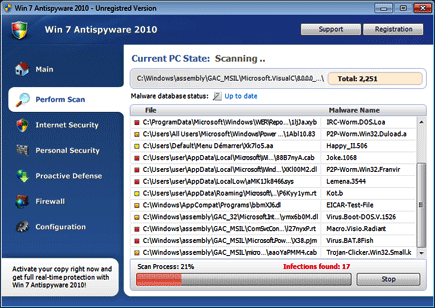
XP Antispyware 2010 will automatically scan the computer and produces fake scan results.
It will modify Windows Registry and add the following entries:
- HKEY_CURRENT_USER\Software\Classes\.exe\shell\open\command “(Default)” = “%UserProfile%\Local Settings\Application Data\av.exe” /START “%1” %*
- HKEY_CURRENT_USER\Software\Classes\secfile\shell\open\command “(Default)” = “%UserProfile%\Local Settings\Application Data\av.exe” /START “%1” %*
- HKEY_CLASSES_ROOT\.exe\shell\open\command “(Default)” = “%UserProfile%\Local Settings\Application Data\av.exe” /START “%1” %*
- HKEY_CLASSES_ROOT\secfile\shell\open\command “(Default)” = “%UserProfile%\Local Settings\Application Data\av.exe” /START “%1” %*
- HKEY_LOCAL_MACHINE\SOFTWARE\Clients\StartMenuInternet\FIREFOX.EXE\shell\open\command “(Default)” = “%UserProfile%\Local Settings\Application Data\av.exe” /START “C:\Program Files\Mozilla Firefox\firefox.exe”
- HKEY_LOCAL_MACHINE\SOFTWARE\Clients\StartMenuInternet\FIREFOX.EXE\shell\safemode\command “(Default)” = “%UserProfile%\Local Settings\Application Data\av.exe” /START “C:\Program Files\Mozilla Firefox\firefox.exe” -safe-mode
- HKEY_LOCAL_MACHINE\SOFTWARE\Clients\StartMenuInternet\IEXPLORE.EXE\shell\open\command “(Default)” = “%UserProfile%\Local Settings\Application Data\av.exe” /START “C:\Program Files\Internet Explorer\iexplore.exe”
- HKEY_LOCAL_MACHINE\SOFTWARE\Microsoft\Security Center “AntiVirusOverride” = “1”
- HKEY_LOCAL_MACHINE\SOFTWARE\Microsoft\Security Center “FirewallOverride” = “1”
The threat will drop the following malicious files:
- %UserProfile%\Local Settings\Application Data\av.exe
- %UserProfile%\Local Settings\Application Data\WRblt8464P
- %UserProfile%\AppData\Local\av.exe
- %UserProfile%\AppData\Local\WRblt8464P
How to Remove XP Antispyware 2010, Win7 Antispyware 2010 and Vista Antispyware 2010 Manually
1. Restart your computer in SafeMode
– After Power-On the computer, just before Windows start, press F8
– From the selections, Select SafeMode
2. Remove Registry entries that the threat added. You MUST BACKUP YOUR REGISTRY FIRST.
– Click Start > Run
– Type in the field, regedit
– Navigate and look for the registry entries mentioned above and delete if necessary
3. Delete malicious files that the threat added:
– Base on the given location above, browse and delete the file
– If no location is given, click Start>Search> and search for the files.
– If cannot be deleted, press Ctrl+Alt+Del to access Task Manager, see if the file is running in the process. If it is, select the file and click End Process. Perform file delete again.
4. Scan computer with Antivirus Program
– Update antivirus program
– Scan computer and delete all detected threats.
How to Easily Remove XP Antispyware 2010
1. Download and run Removal Tool to remove XP Antispyware 2010
